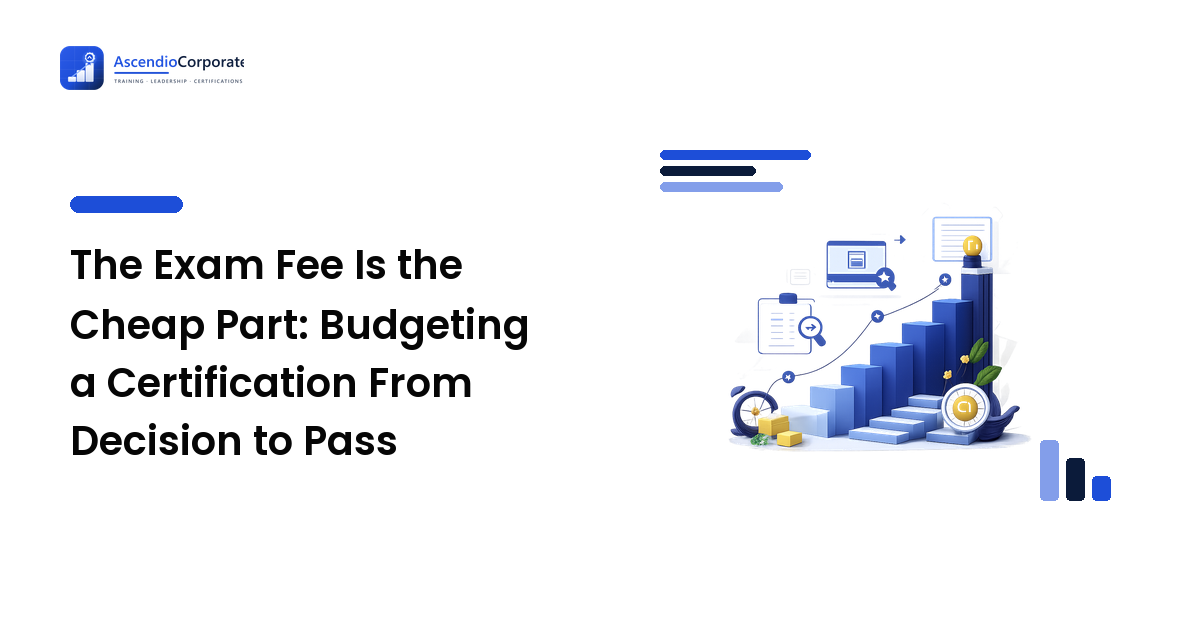
Ask what a certification costs and you will be quoted the exam fee, because that is the number printed on the certifying body's pricing page. It is almost never the number that leaves your bank account. Around that one visible figure sits a quieter ecosystem — application fees, sometimes-mandatory training, prep courses, practice exams, a possible retake, and the renewal meter that starts running the day you pass — and it is entirely normal for the surrounding spend to outweigh the exam itself several times over.
None of that makes certification a bad buy. It makes it a purchase that deserves a real budget. The decision rule of this whole article: price the path, not the exam — then judge each line item by what it actually changes about your odds of passing and using the credential. Some of those line items are the best money in professional development. Others exist mostly because anxious candidates are easy to sell to. This guide walks the budget in the order the costs arrive, and flags which is which. It pairs with the broader question of whether the credential deserves the money at all, which is the territory of how to tell if a course or certification is worth it.
Start with the entry ticket: exam, application, and eligibility
The exam fee is the anchor, but read the fine print around it before you treat it as the whole ticket. Depending on the certifying body, the entry price can also include a separate application or eligibility-review fee, a required membership (which sometimes discounts the exam enough to pay for itself — do that arithmetic), and per-attempt proctoring arrangements. Remote proctoring has made the logistics cheaper for most people, but if your exam requires a test centre, travel is a real line item for anyone not near a city.
Two habits protect you here. First, price the exam from the certifying body's own current page, not from a blog or a course provider — fees change, and secondhand numbers age badly. Second, note the retake price while you are there. You want it now, for the budget, not later, as a surprise.
The line item that can dwarf everything: required training
Some certifications are exam-only: study however you like, show up, pass. Others formally require an approved course, a set number of training hours, or documented experience before you may even register. That single fact changes the budget more than anything else on this page, because mandatory training from approved providers is priced accordingly — and because discovering the requirement after you have committed to a credential is how budgets double overnight.
So check prerequisites before you fall for a certification, not after. The requirement structure — and whether the credential's recognition justifies it — belongs to the choosing decision itself, covered in how to choose a professional certification. For budgeting purposes the rule is simple: an exam-only credential and a training-mandatory credential are different products at different price points, even when the certificates look similar on a CV.
Prep: where budgets quietly double
Here is where the money actually gets spent, and where the most genuine choices live. Prep spending runs on a spectrum:
- Self-study — the official exam guide, a book or two, maybe a video-course subscription. The cheapest route, and for disciplined studiers with some background in the subject, often the right one. What it does not buy you is feedback, accountability, or anyone to ask.
- Instructor-led courses and bootcamps — the expensive route, and worth it in specific, nameable situations: the material is far from your experience, you need lab environments you cannot easily build yourself, your motivation collapses without external structure, or your employer is paying and the time saved matters more than the fee. Buy the instructor for the interaction and the structure. If you would just be watching lectures alone anyway, buy the cheaper recording of the same lectures.
- The bundle — many providers sell course, materials, practice exams, and sometimes a voucher in one package. Bundles are neither scam nor bargain by nature; unbundle them mentally, price the parts you would actually use, and compare. A discount on components you never open is not a discount.
The pattern worth noticing: prep sellers price against your anxiety, not against the content. The antidote is a study plan first, spending second — decide how you will prepare, then buy only what that plan needs. Building that plan is its own skill, covered in how to study for a certification exam.
Practice exams: the best money in the budget
If one prep purchase earns its price almost every time, it is realistic practice exams. The reason is mechanical, not motivational: a good practice exam is a diagnostic — it tells you which topics need work while there is still time to do the work — and it makes the exam format itself familiar, so none of your paid attempt is spent decoding question styles. Measured against the cost of a single retake, a practice-exam package is usually the cheapest insurance available. Prefer sources with real explanations attached to answers; a score without a reason teaches you nothing. And avoid "exam dumps" of leaked real questions entirely — they violate the exam agreements candidates sign, and certifying bodies do revoke credentials over them. That is a way to spend the whole budget and end up with nothing.
Budget for one retake — as insurance, not pessimism
Capable, prepared people fail credential exams on the first attempt; it happens routinely enough that a serious budget treats one retake as a contingency line, not a personal insult. Practically: know the retake fee and the mandatory waiting period before you book the first attempt, and if a provider offers a modestly priced retake voucher or "second shot" arrangement, weigh it like any insurance — sensible when the exam fee is high relative to the voucher, skippable when a retake costs little. What the contingency buys you is calm: candidates who cannot afford to fail sit exams badly.
The line item that never appears in currency: your hours
The largest cost of most certifications is study time, and it behaves like money in every way that matters — it is scarce, it has alternative uses, and different credentials demand wildly different amounts of it. Two certifications with similar fees can differ by months of evenings. When you compare options, put an honest hours estimate next to the fees, and remember that "employer pays the fee" does not mean "employer pays the evenings". A cheap credential that eats a year of your discretionary time is not cheap.
Ways to shrink the bill without shrinking your odds
- Ask about employer funding before you enrol, not after. Training budgets commonly cover job-relevant certifications, and some employers also fund study time. The order matters: approval first, receipts second.
- Check membership pricing. Where a body's member discount exceeds the membership fee, joining is arithmetic, not loyalty.
- Use the certifying body's free materials first. Official exam outlines, sample questions, and documentation are authoritative and free; third-party prep should fill the gaps they leave, not substitute for reading them.
- Time-box subscriptions. Video platforms and lab environments billed monthly reward a concentrated study plan; a subscription held "just in case" for a year quietly outspends a bootcamp.
- Watch version timing. Exams get retired and replaced; enrolling in prep for a version about to sunset is money spent learning the wrong test. Check the body's exam-version schedule before buying materials.
The meter keeps running after you pass
The budget in this article ends at the pass mark, but the spending does not. Most respected credentials run on renewal cycles — continuing-education credits, maintenance fees, sometimes re-examination — and the multi-year upkeep can reorder which of two certifications is genuinely cheaper. Before you commit to anything on the strength of this budget, price the ongoing side too: what it really costs to keep a certification active walks that half of the ledger.
FAQ
How much should I budget for a certification in total? Build it from parts rather than a rule of thumb: current exam and application fees from the certifying body's own page, any mandatory training, the prep your study plan actually needs, a practice-exam package, one retake as contingency, and the first renewal cycle. The exam fee alone is a reliable underestimate.
Is an expensive bootcamp worth it, or should I self-study? Neither is universally right. Instructor-led prep earns its price when you need structure, labs, or fast answers to questions; self-study wins when you have background in the topic and the discipline to follow your own plan. Decide the study plan first, then buy what it requires.
What is the most worthwhile prep purchase? Realistic practice exams with explained answers, in most cases. They diagnose weak topics while you can still fix them, familiarise you with the format, and cost little compared to a retake.
Can I get my employer to pay for a certification? Often, when the credential is relevant to your role — employer funding of certifications is common. Ask before enrolling, follow the approval process, and check whether study time, not just fees, can be covered.
A certification bought on a full budget is a decision; one bought on the exam fee alone is a series of surprises. Price the path — entry, training, prep, practice, contingency, renewal — and then weigh credentials against each other on their whole cost. When you are ready to do that side by side, compare certifications on Ascendio and choose the one whose complete price tag still looks like a good deal.